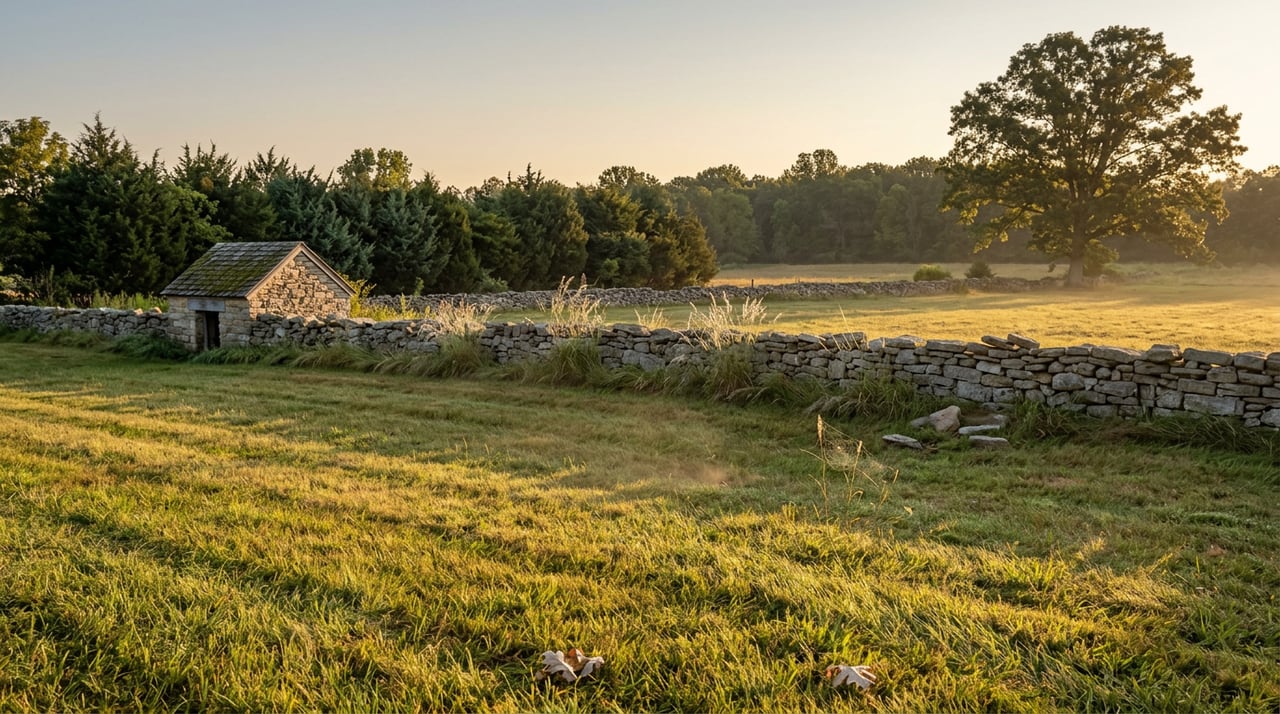
Drive the back roads around The Plains long enough and you will pass a small stand of cedars ringed by a wrought iron fence, sitting in the middle of an otherwise unbroken hayfield. No house nearby, no gate wide enough for a car. Just a dozen leaning stones and a fence line that has clearly outlived several owners. Buyers touring the farm behind it usually treat the plot as a curiosity, a piece of the property's character worth a photo before moving on to the barn.
It is not a curiosity. It is a separate legal question sitting inside the one you came to answer, and Virginia has arranged things so that nobody is required to raise it before you sign.
The Disclosure Form Says Nothing, on Purpose
Virginia's Residential Property Disclosure Act requires sellers to hand buyers a signed statement before a contract becomes binding, but the form is built around a short list of specific issues: septic waivers, proximity to military air installations, pending zoning violations, repetitive flood loss. A private cemetery on the property is not on that list. Virginia law places no duty on a seller, or on the seller's agent, to investigate or volunteer that a burial ground exists on land being sold between private parties. The state remains, in the language legal commentators use for it, a buyer-beware jurisdiction on this specific point.
That silence is not an oversight. It reflects how common the fact pattern is across rural Virginia, where generations of farm families buried their own on the land they worked rather than in a town cemetery. The state did not build a disclosure requirement around something this ordinary. It built an access statute instead, one that attaches to the land regardless of whether the sale contract ever mentions it.
Virginia law does not even require a cemetery to have a boundary, a marker, or a recorded deed to count as one. A burial is enough. That means the absence of a fence, a headstone, or any paperwork in your title package does not tell you a farm is free of one. It tells you only that nobody has found it yet.
What You Actually Inherit When You Buy the Land
Once you close on land that includes a burial ground, whether you knew about it or not, state law hands you a set of obligations that has nothing to do with your purchase contract. Virginia Code § 57-27.1 requires the owner of private property containing a cemetery or graves to allow ingress and egress to family members and descendants of the people buried there, to any cemetery plot owner, and to anyone conducting genealogical research, provided they give reasonable notice. You may set the hours, frequency, and duration of that access. You may not erect a fence, wall, or other structure that blocks it entirely, though a gate satisfies the law.
For deaths before July 1, 2024, a related statute, § 57-27.1:1, goes further. It allows immediate family members and descendants to petition the circuit court for the right to inter additional relatives within the existing perimeter of a documented family cemetery, with the boundary set by a survey the landowner and petitioner agree on and the cost split between them. In other words, a family cemetery is not necessarily a closed chapter when you buy the farm around it. It can, in narrow circumstances, still be an open one.
The penalties behind these rights are not symbolic. Displacing human remains in Virginia is a Class 4 felony, punishable by two to ten years in prison and up to $100,000 in fines, a standard that applies whether the burial is prehistoric, historic, or recent. Willful or malicious damage to gravestones or cemetery fencing carries its own penalty, up to five years and $25,000. A landowner who decides a small fenced plot is more trouble than it is worth, and quietly clears it, is not making a landscaping decision. They are making a felony decision.
The Word That Actually Matters: Reserved vs. Excepted
Old Piedmont deeds tend to describe family burial grounds with a specific piece of language: the grantor conveys the farm while "reserving" a portion for use as a family cemetery. Buyers who encounter that clause often assume it means the cemetery parcel was carved out of the sale entirely, still owned by the original family rather than by them.
Virginia courts have read it the other way. A reservation of this kind is generally treated as conveying full fee ownership of the cemetery ground to the buyer, while creating a separate right, an easement in gross, that lets the reserving family continue to use and visit it. You end up owning the dirt. They keep the right to walk on it.
That distinction has a real consequence when the cemetery has no obvious access route left, or when the visiting family's road to it crosses land you do not own. A Virginia court addressing exactly this kind of dispute held that a landowner whose property contains the traditional path to a cemetery, but not the cemetery itself, is not required to let visitors cross that path. The obligation to provide access falls on whoever owns the ground the graves are actually on, not on every neighbor a visitor might otherwise prefer to cut through. If you are the one who owns the cemetery parcel itself, the court noted that doctrines like easement by necessity would still require someone to provide you a way in, but the exact route is not guaranteed to be the one that already exists.
What a Title Search Can and Can't Tell You
Fauquier County's Circuit Court Records Room holds deed books going back to the county's formation in 1759, with digitized images available from Book 215 forward. Staff there can point you to the right book and page, but they will tell you directly that they do not perform title searches themselves. That work falls to a title abstractor, and for land with any depth of ownership history, the search needs to go back further than most standard 30 or 60-year title exams typically run, since a reservation clause recorded in 1890 can still bind the land today.
Because no marker or deed is legally required for a burial to exist, county government treats rural cemeteries as a genuinely unsolved inventory problem rather than a closed one. Fauquier County has said plainly that its cemeteries are among its most endangered heritage resources precisely because so many remain unidentified and unmapped, which is why the county maintains a voluntary Cemetery Field Documentation Form inviting landowners and descendants to record what they know. If a cemetery on the farm you are buying has never been documented that way, a title search and a walk of the property boundary are the only tools you have before closing.
Genealogy researchers are one of the three groups the statute protects, alongside family members and plot owners, and Fauquier County is home to an organization built around exactly that work. The Afro-American Historical Association of Fauquier County keeps its resource center in The Plains and assists families researching ties to the county's historic Black communities, a reminder that the statutory right of access is not theoretical here. It has a local address.
Questions Worth Asking Before You Write an Offer
- Ask the seller directly whether they are aware of any graves, marked or unmarked, anywhere on the property, since the law does not require them to volunteer it.
- Request a title abstract that traces the chain of ownership as far back as county deed books allow, looking specifically for language reserving or excepting a burial ground.
- Confirm whether any cemetery is platted as a separate parcel or sits inside your tract's boundary as recorded.
- Ask whether anyone has visited or maintained the plot recently, since an established pattern of use is what the county recognizes as a traditional access route.
- Have your attorney or title company confirm in writing whether any recorded easement in gross or interment right exists, and how it would affect your title insurance.
Where This Leaves You
None of this makes a family cemetery a reason to walk away from an otherwise sound farm. It is closer to a conservation easement or a shared right-of-way, a permanent condition attached to specific ground that a buyer needs to understand and plan around rather than discover after the fact. Land near The Plains has carried families, and their dead, for a long time. Buying it well means reading the deed as carefully as you read the barn roof.
If you are evaluating a farm near The Plains and want a second set of eyes on what an old deed actually reserves, Brett Molenaar has spent nearly two decades working through exactly this kind of title detail on Hunt Country land. Let's Connect.